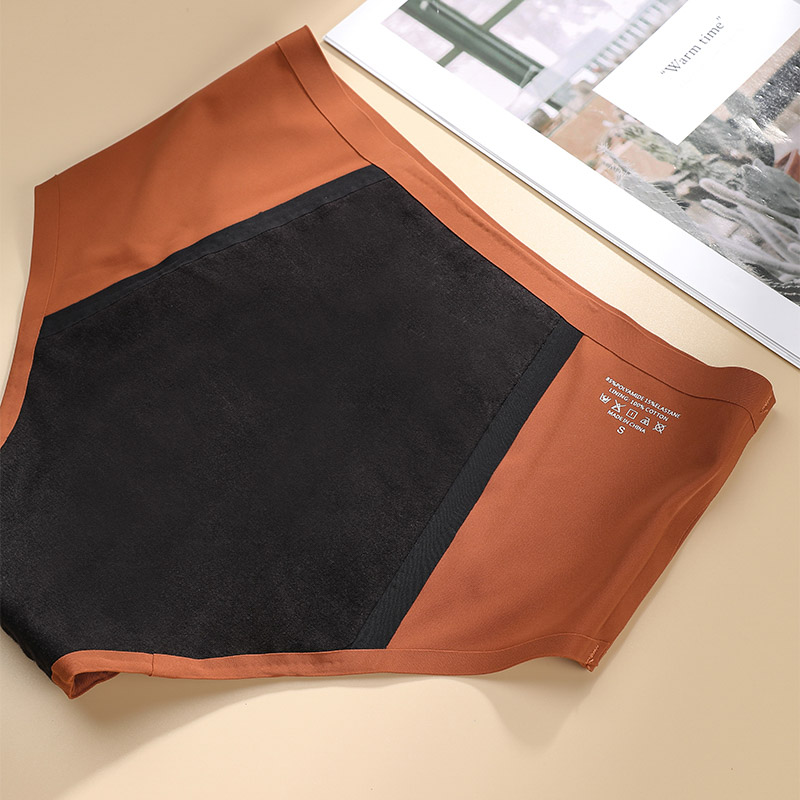
In recent years, public opinion on menstrual underwear has completely changed.
Buyers now consider more than just absorbency and comfort when purchasing menstrual underwear. More and more brands are focusing on key factors such as fabric safety, whether prolonged wear will cause stuffiness, the absence of illegal chemical additives, and the transparency and reliability of the production process.
Of all these concerns, the complete absence of PFAS-free harmful chemicals in the production process has become the most crucial issue for the washable and reusable menstrual underwear industry.
Whether it's a new lingerie brand or a wholesaler and retailer focusing on environmentally friendly and sustainable products, finding a truly reliable PFAS-Free Period Underwear Manufacturer is no longer just about simple procurement; it's about mitigating risk and controlling quality.However, there's a problem in the market now: the "PFAS-free" label is being misused and overhyped.
Some suppliers treat this as a marketing gimmick, completely unaware of the underlying professional standards; others simply remove PFAS from one layer of fabric while using chemically treated materials for the other layers, yet claim it's completely PFAS-free.
Therefore, understanding the internal structure and manufacturing principles of menstrual underwear is far more important than relying solely on advertising claims.
At Chuangrong, we've also found that purchasing clients who truly understand the internal structure of Reusable period panties have more stable and long-term purchasing partnerships.
In fact, the difference between reliable and unreliable menstrual underwear lies not in its appearance, but entirely in the internal lining structure that is invisible to the average person.
Understanding 4-Layer Absorbency Period Underwear Technology
Modern 4-layer absorbency period underwear technology is designed to solve several problems simultaneously: moisture management, absorption capacity, leakage prevention, breathability, wash durability, and skin comfort.
A properly engineered structure is not simply “thicker fabric.” Each layer serves a different functional role.
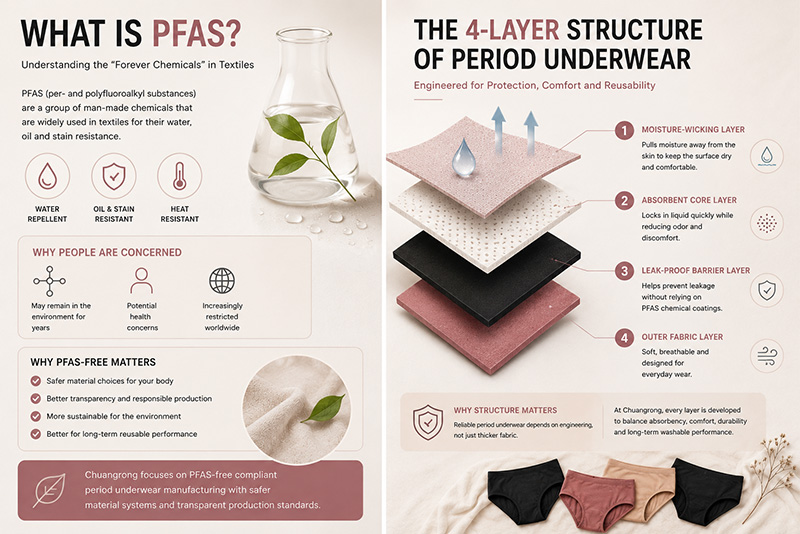
The first layer, which sits closest to the skin, is responsible for moisture transfer. Its purpose is to move liquid away from the surface quickly so the wearer does not feel wet for long periods of time. Poor-quality surface fabrics often create a damp feeling even when the absorbent core is technically working.
The second layer acts as the absorbency core. This is where fluid retention capacity is built. The density, fiber composition, and distribution structure of this layer directly affect how much liquid the garment can hold without becoming bulky. Some factories focus only on increasing thickness, but excessive thickness often reduces flexibility and daily comfort.
The Hidden Challenge of PFAS-Free Leak Protection
The third layer is crucial in differentiating menstrual underwear in terms of quality; it's typically the leak-proof and waterproof layer.
Previously, many factories relied on chemical additives and fluorine treatments for waterproofing and leak prevention. However, with global concerns about harmful chemicals like PFAS, responsible factories have begun using **alternative waterproof membranes** and safer fabric formulations.
But a complete replacement is not easy.
To eliminate PFAS entirely while maintaining leak-proof performance requires meticulous fabric selection and repeated production and washing tests. Some smaller factories fail to do this properly, resulting in underwear that easily deteriorates and loses its leak-proof properties after a few washes because their leak-proof structure wasn't designed for repeated wear and washing.
This is the biggest pitfall in the current washable menstrual underwear market.
Many new products appear fine during initial factory testing, but after several washes by customers, the leak-proof effect gradually diminishes and eventually becomes ineffective.
From a wholesale order perspective, this is extremely risky: it easily leads to customer complaints, soaring return rates, and can ruin the brand's reputation.
Factory owners with real experience in producing PFAS-free menstrual underwear know that simply meeting chemical standards is far from enough; the real skill lies in ensuring stable performance and durability after washing.
Why Product Structure Affects Consumer Experience
The fourth layer is usually focused on structural support, shape stability, and external appearance. This layer influences whether the underwear still feels like regular lingerie rather than medical-functional wear. Consumers increasingly expect period underwear to look minimal, seamless, and wearable in everyday situations.
This is where manufacturing experience becomes critical.
Factories that only recently entered the period underwear category often underestimate how difficult it is to balance absorbency with aesthetics. Once multiple functional layers are added, problems such as edge curling, stiffness, poor stretch recovery, or visible absorbent lines become common.
This is also where advanced 4-layer absorbency period underwear technology becomes important, because the layering system directly affects both comfort and long-term durability.
What Buyers Should Actually Evaluate in a Manufacturer
Therefore, for buyers, choosing a manufacturer shouldn't be based solely on certifications or attractive product brochures.
The truly crucial factor is whether the factory can clearly explain its material combinations and product structure principles. Reliable factories will honestly explain the function of each absorbent layer, how they achieve leak-proof and seepage-proof performance without harmful PFAS chemicals, and whether the product's performance will deteriorate after multiple washes, or if it will still be usable.
Another extremely important point is the factory's R&D and design capabilities.
The market for washable and reusable intimate apparel changes rapidly. Customers in different countries and regions have varying preferences regarding absorbency, fabric feel, crotch height, and sizing standards. Some brands focus on youth styles, while others specialize in styles for postpartum women and active individuals. Only factories with strong R&D capabilities can keep up with diverse market demands and changing trends.
In our business at Chuangrong, we've found that long-term clients don't simply look for the cheapest factory; they prioritize minimizing risk and uncertainty.
What they want is:
- Consistently stable and problem-free quality control;
- Transparent and clear communication regarding fabric sourcing and material information;
- Mass production that is exactly the same as the initially confirmed sample.
Most importantly, they want to find knowledgeable partner factories that understand that this kind of reusable underwear is not a disposable fast-moving consumer good.
Consumers will wear and wash it repeatedly over a long period of time, and eventually, any small design flaws or workmanship issues will become apparent.
The Future of Reusable Period Panties Manufacturing
Going forward, the production of menstrual underwear will increasingly prioritize the fabric and raw materials themselves.
With increasingly stringent global regulations on PFAS chemicals, brands are more inclined to partner with factories that already understand and utilize compliant, environmentally friendly materials, rather than hastily switching suppliers when regulations tighten.
Therefore, choosing a menstrual underwear factory that is completely PFAS-free is not just about purchasing goods; it's a long-term strategic move for the brand, directly impacting customer retention, brand image, and product durability.
Brands that have achieved long-term success in the washable menstrual underwear market place great emphasis on aspects unseen by the consumer: internal structure and workmanship, the quality of materials used, and the professional layered design beneath the fabric.
This is precisely what Chuangrong has always insisted on: relying on mature and stable material solutions, professional multi-layered absorbent structure design, and strict production control to produce menstrual underwear that fully complies with PFAS-free standards. Every detail can withstand repeated wear and washing, and its performance remains undiminished over long-term use.
📩 Email: Lexie@Sharicca.com
🌐 Website: www.chuangrongapparel.com